
Absolutely. Below is a long, beginner-friendly, SEO-optimized blog designed for your digital marketing website. It includes clear H2/H3 sections, examples, comparison tables, FAQs, and SEO metadata.
Search Engine Optimization, commonly known as SEO, is one of the most important parts of digital marketing. If you have a website, blog, online store, or business website, SEO can help people discover your content through search engines.
However, SEO is not just about adding keywords to a webpage.
A successful SEO strategy includes several different activities. Two of the most important areas are On-Page SEO and Off-Page SEO.
While both strategies have the same broad objective of improving a website’s search visibility, they focus on different areas.
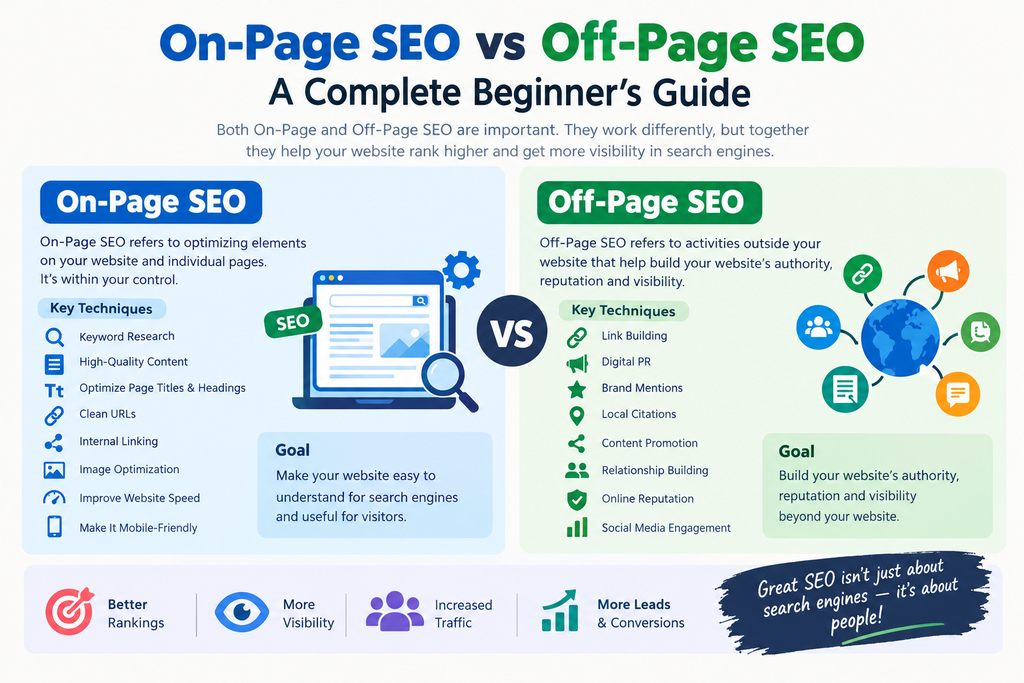
On-Page SEO focuses on elements that you can optimize directly on your website.
Off-Page SEO focuses on activities outside your website that can contribute to its authority, reputation, and visibility.
Understanding the difference between On-Page SEO and Off-Page SEO is important for beginners because both are connected. A website with excellent content but little authority may struggle to gain visibility, while a website with many external links but poor content may provide a weak experience for visitors.
In this complete beginner’s guide, we will explain what On-Page SEO is, what Off-Page SEO is, their differences, important techniques, examples, benefits, common mistakes, and how you can use both strategies together.
What Is SEO?
SEO stands for Search Engine Optimization.
It is the process of improving a website and its content so that search engines can better understand its pages and users can discover relevant information through search.
For example, imagine that you run a digital marketing agency.
You may want your website to appear when potential customers search for terms such as:
- Digital marketing agency
- SEO services
- Google Ads services
- Social media marketing services
- Digital marketing consultant
- SEO agency near me
SEO can help your website become more visible for relevant searches.
However, ranking is not based on one single factor.
Search engines consider many signals when determining which pages to show for a particular search. These can include content relevance, website structure, links, usability, authority, and many other factors.
That is why SEO should be treated as a complete strategy rather than a single task.
What Is On-Page SEO?
On-Page SEO refers to optimizing elements on your website and individual webpages to help search engines understand the content and help users find useful information.
The important thing to understand is that On-Page SEO is largely within your control.
You can improve your:
- Page titles
- Headings
- Content
- Keywords
- URLs
- Internal links
- Images
- Image alt text
- Meta descriptions
- Content structure
- Website navigation
- User experience
For example, if you are writing an article about digital marketing for small businesses, you can optimize the page title, headings, content structure, internal links, images, and other relevant elements.
The goal is not simply to add keywords repeatedly.
Instead, the goal is to create a page that is relevant, useful, easy to understand, and technically accessible to search engines.
Why Is On-Page SEO Important?
On-Page SEO helps search engines understand what your webpage is about.
Imagine that you publish an article titled:
“10 Digital Marketing Strategies for Small Businesses”
The page should clearly communicate the topic through its title, headings, content, URL, and supporting information.
Good On-Page SEO can help:
- Improve content relevance
- Make webpages easier to understand
- Improve website navigation
- Create a better user experience
- Help search engines discover important pages
- Support organic search visibility
- Improve content organization
Most importantly, On-Page SEO gives you control over many elements of your website.
Important On-Page SEO Techniques
Let’s look at some of the most important On-Page SEO techniques beginners should understand.
1. Keyword Research
Keyword research is an important part of SEO.
A keyword is a word or phrase that people use when searching for information, products, or services.
For example:
“digital marketing services in Mumbai”
could be a relevant search phrase for a digital marketing agency targeting customers in Mumbai.
Other examples include:
- SEO services
- Google Ads agency
- Social media marketing
- Digital marketing course
- Local SEO services
- SEO consultant
Keyword research helps you understand what your target audience is searching for.
However, avoid choosing keywords simply because they have high search volume.
The keyword should also be relevant to your business and the searcher’s intent.
2. Create High-Quality Content
Content is one of the most important parts of On-Page SEO.
Your content should answer the user’s question clearly and provide genuine value.
For example, if someone searches:
“What is Off-Page SEO?”
a useful article should explain:
- What Off-Page SEO means
- Why it matters
- Common Off-Page SEO techniques
- Examples
- Common mistakes
- How beginners can get started
Instead of writing content only for search engines, write for real people first.
Useful content can also encourage visitors to spend more time exploring your website.
3. Optimize the Page Title
The page title tells users and search engines what a webpage is about.
For example:
On-Page SEO vs Off-Page SEO: A Complete Beginner’s Guide
is a clear title for this article.
A good title should:
- Describe the topic accurately
- Be relevant to the search intent
- Encourage users to click
- Include the primary topic naturally
Avoid creating misleading titles simply to attract clicks.
4. Use Proper Headings
Headings help organize your content.
A well-structured article may use:
H1: Main article title
H2: Major sections
H3: Subsections
For example:
H1
On-Page SEO vs Off-Page SEO: A Complete Beginner’s Guide
H2
What Is On-Page SEO?
H2
What Is Off-Page SEO?
H3
Backlinks
H3
Brand Mentions
This structure makes long articles easier to read and understand.
5. Optimize URLs
A clean URL can make a webpage easier to understand.
For example:
Good URL:
yourwebsite.com/on-page-vs-off-page-seo/
A complicated URL containing unnecessary characters and parameters may be less user-friendly.
Keep URLs descriptive and reasonably short.
6. Use Internal Links
Internal links connect one page of your website to another page on the same website.
For example, if you publish an article about Off-Page SEO, you can link to another relevant article about:
- SEO basics
- Keyword research
- Local SEO
- Technical SEO
- Content marketing
- Digital marketing
Internal linking can help users discover related content and can help search engines understand the relationship between pages on your website.
7. Optimize Images
Images can make your content more engaging.
However, images should also be optimized for performance and accessibility.
Important image optimization practices include:
- Use descriptive file names
- Compress large images
- Use appropriate image formats
- Add meaningful alt text where appropriate
- Avoid unnecessarily large image files
For example, instead of naming an image:
IMG12345.jpg
you could use a descriptive filename such as:
on-page-off-page-seo-guide.jpg
8. Improve Website Speed
Website performance is important for user experience.
If a webpage takes too long to load, visitors may leave before reading the content.
You can improve performance by:
- Compressing images
- Reducing unnecessary scripts
- Using efficient hosting
- Optimizing website code
- Using caching where appropriate
- Monitoring Core Web Vitals
A faster website can create a better experience for visitors.
9. Make Your Website Mobile-Friendly
Many people access websites using smartphones.
Therefore, your website should work properly across different screen sizes.
Make sure:
- Text is easy to read
- Buttons are easy to tap
- Images fit the screen
- Navigation works properly
- Pages load efficiently
Mobile usability should be considered when designing and optimizing your website.
What Is Off-Page SEO?
Off-Page SEO refers to activities performed outside your own website that can help build your website’s reputation, authority, visibility, and relationships across the web.
Unlike On-Page SEO, many Off-Page SEO activities happen outside your website.
One of the best-known examples is link building.
If another relevant and trustworthy website links to your website, that link can potentially contribute to how search engines understand the authority and relevance of your site.
However, Off-Page SEO is not limited to backlinks.
It can also involve:
- Digital PR
- Brand mentions
- Relationship building
- Relevant citations
- Online reputation
- Community participation
- Content promotion
- Genuine business partnerships
The key principle is quality.
Trying to manipulate search rankings through spammy or artificial techniques can create problems rather than helping your website.
Why Is Off-Page SEO Important?
Search engines need ways to understand whether a website is trustworthy and authoritative.
External signals can provide additional context.
For example, imagine you publish a detailed article about SEO.
If respected websites in the marketing industry independently reference your research or content, those external references can contribute to your website’s overall online reputation.
Off-Page SEO can help with:
- Building website authority
- Increasing brand visibility
- Earning referral traffic
- Building industry relationships
- Increasing brand mentions
- Supporting organic search visibility
However, Off-Page SEO should be built naturally.
Important Off-Page SEO Techniques
1. Link Building
Link building involves earning links from other websites to your website.
For example, suppose you publish a detailed guide about local SEO.
A marketing website may discover your guide and link to it as a useful resource.
That is an example of an earned backlink.
Good link-building strategies focus on relevance, usefulness, and quality.
2. Digital PR
Digital PR involves promoting valuable information or stories online to earn attention, coverage, and references.
For example, a business could publish:
- Original research
- Industry statistics
- Surveys
- Expert insights
- Data studies
- Useful reports
If journalists, bloggers, or industry websites find the information valuable, they may reference it.
This can generate brand exposure and potentially earn links.
3. Brand Mentions
A brand mention occurs when another website or online platform mentions your business.
A mention may or may not contain a backlink.
Even when there is no direct link, brand visibility can contribute to awareness and reputation.
For example:
DigitalAkhil could be mentioned in a digital marketing article as a marketing resource.
4. Local Citations
Local businesses can benefit from accurate business information across relevant online directories and platforms.
Important business information can include:
- Business name
- Address
- Phone number
- Website
- Business category
Consistency is important because incorrect or conflicting information can create confusion for customers.
5. Content Promotion
Creating excellent content is only one part of content marketing.
You also need to promote it.
You can promote content through appropriate channels such as:
- Social media
- Email newsletters
- Industry communities
- Partnerships
- Outreach
- Relevant online publications
The objective is to get your content in front of people who may genuinely find it useful.
6. Relationship Building
SEO is not only about algorithms.
Building relationships with people in your industry can create opportunities for:
- Collaborations
- Interviews
- Guest contributions
- Expert quotes
- Partnerships
- Content promotion
Over time, these relationships can increase your brand’s visibility.
On-Page SEO vs Off-Page SEO: Key Differences
The biggest difference between On-Page SEO and Off-Page SEO is where the optimization happens.
| On-Page SEO | Off-Page SEO |
|---|---|
| Happens primarily on your website | Happens primarily outside your website |
| Focuses on webpage optimization | Focuses on external reputation and authority |
| Includes content optimization | Includes link earning and digital PR |
| Includes titles and headings | Includes external references |
| Includes internal linking | Includes backlinks |
| Includes image optimization | Includes brand mentions |
| You have more direct control | You have less direct control |
| Focuses heavily on relevance and usability | Focuses heavily on reputation and authority |
Both are important parts of a broader SEO strategy.
On-Page SEO vs Off-Page SEO Example
Let’s use a simple example.
Imagine that you own a website offering digital marketing services in Mumbai.
You publish a page targeting the topic:
Digital Marketing Services in Mumbai
Your On-Page SEO strategy could include:
- Creating useful service content
- Using a clear page title
- Adding relevant headings
- Optimizing the URL
- Adding internal links
- Using relevant keywords naturally
- Adding useful images
- Improving page speed
- Making the page mobile-friendly
Now consider the Off-Page SEO side.
You could focus on:
- Earning relevant industry backlinks
- Getting mentioned in business publications
- Building relationships with relevant websites
- Promoting useful marketing research
- Maintaining accurate local business information
- Increasing brand visibility
The two strategies work together.
Which Is More Important: On-Page SEO or Off-Page SEO?
It is better not to think of On-Page SEO and Off-Page SEO as competing strategies.
They solve different problems.
On-Page SEO helps make your website and content useful, understandable, and well-structured.
Off-Page SEO can help build authority, reputation, and visibility beyond your own website.
A strong SEO strategy can therefore use both.
For example:
Useful Content + Technical Optimization + Internal Linking + External Authority + Brand Visibility
can create a stronger overall SEO foundation than focusing on only one area.
On-Page SEO and Off-Page SEO Work Together
Think about SEO like building a house.
Your website is the house.
On-Page SEO is similar to improving the structure, rooms, design, organization, and information inside the house.
Off-Page SEO is similar to building the reputation of that house in the surrounding community.
If your website has excellent external links but poor content, visitors may not find what they need.
If your website has excellent content but nobody discovers or references it, it may take longer to build visibility.
Therefore, both areas deserve attention.
Common On-Page SEO Mistakes
Beginners often make several On-Page SEO mistakes.
Keyword Stuffing
Keyword stuffing means repeatedly using a keyword unnaturally in an attempt to influence search rankings.
For example:
“Best SEO services are the best SEO services for businesses looking for SEO services.”
This creates a poor reading experience.
Instead, use keywords naturally and focus on answering the user’s question.
Duplicate Content
Publishing substantially duplicated content across multiple pages can create SEO and usability issues.
Each important page should have a clear purpose.
Ignoring Search Intent
A page should match what the user is actually looking for.
If someone searches:
“What is SEO?”
they probably want an explanation rather than a page containing only a sales pitch.
Understanding search intent can help you create more relevant content.
Poor Internal Linking
Important pages should be easy to discover through logical navigation and relevant internal links.
Ignoring Mobile Users
A website that works poorly on smartphones can create a frustrating experience.
Common Off-Page SEO Mistakes
Off-Page SEO also has potential pitfalls.
Buying Low-Quality Links
Buying large numbers of poor-quality or irrelevant backlinks can create risks.
Instead, focus on earning relevant and legitimate references.
Using Spammy Directories
Submitting a website to hundreds of low-quality directories is not a sustainable SEO strategy.
Focus on relevant, legitimate platforms.
Excessive Guest Posting for Links
Guest contributions can be useful when they provide genuine value and reach a relevant audience.
However, creating large amounts of low-quality content primarily for backlinks is not a good long-term approach.
Ignoring Relevance
A backlink from a completely unrelated website may not be as meaningful as a relevant reference from a trusted website in your industry.
Focusing Only on Backlinks
Off-Page SEO is broader than link building.
Brand reputation, digital PR, relationships, mentions, and content promotion can also matter.
How to Create an SEO Strategy for Your Website
If you are a beginner, you do not need to implement everything at once.
Start with a structured process.
Step 1: Understand Your Audience
Identify the people you want to attract.
Ask:
- What are they searching for?
- What problems do they have?
- What products or services do they need?
- What questions do they ask?
Step 2: Conduct Keyword Research
Find relevant keywords related to your products, services, and content.
Group related keywords into topics instead of creating separate pages for every minor keyword variation.
Step 3: Build Useful Content
Create articles, service pages, guides, and other resources that genuinely answer customer questions.
Step 4: Optimize Your Website
Review:
- Page titles
- Headings
- URLs
- Internal links
- Images
- Meta descriptions
- Mobile usability
- Website performance
Step 5: Promote Your Content
Share useful content through relevant channels.
Build relationships with people and organizations in your industry.
Step 6: Earn Quality References
Create resources that other websites have a reason to reference.
Original research, useful guides, statistics, tools, and expert insights can be effective content assets.
Step 7: Monitor Performance
Track important SEO metrics over time.
You may monitor:
- Organic traffic
- Search impressions
- Search clicks
- Click-through rate
- Keyword visibility
- Indexed pages
- Backlinks
- Leads
- Conversions
Do not focus on one metric alone.
How Long Does SEO Take?
SEO does not have a fixed timeline.
The time required to see meaningful results can depend on factors such as:
- Website age
- Competition
- Industry
- Content quality
- Technical condition
- Website authority
- Search demand
- SEO strategy
- Consistency
Some changes may produce improvements relatively quickly, while competitive search terms can require sustained effort.
Therefore, SEO should generally be viewed as a long-term digital marketing strategy rather than a one-time task.
SEO for Small Businesses
Small businesses can use both On-Page and Off-Page SEO to build online visibility.
For example, a local business can:
- Create a professional website.
- Build dedicated pages for important services.
- Research relevant local keywords.
- Publish helpful blog content.
- Optimize its Google Business Profile.
- Maintain consistent business information.
- Earn relevant local mentions.
- Build relationships with local organizations.
- Collect genuine customer reviews.
- Monitor website and search performance.
A consistent strategy can help create a stronger digital presence over time.
On-Page SEO Checklist
Before publishing a webpage, use this simple checklist:
- Does the page satisfy the user’s search intent?
- Is the main topic clear?
- Is the page title descriptive?
- Are headings properly organized?
- Is the content useful and original?
- Are keywords used naturally?
- Is the URL clean?
- Are relevant internal links included?
- Are images optimized?
- Is the page mobile-friendly?
- Does the page load efficiently?
- Is the content easy to read?
- Does the page have a clear purpose?
Off-Page SEO Checklist
Use this checklist when developing your Off-Page SEO strategy:
- Are you creating content worth referencing?
- Are backlinks coming from relevant sources?
- Are you avoiding spammy link-building techniques?
- Are you promoting useful content?
- Are you building industry relationships?
- Is your business information accurate?
- Are you monitoring brand mentions?
- Are you developing genuine digital PR opportunities?
- Are you focusing on quality rather than quantity?
Frequently Asked Questions
What is the difference between On-Page SEO and Off-Page SEO?
On-Page SEO focuses on optimizing elements within your website, such as content, titles, headings, URLs, internal links, and images. Off-Page SEO focuses on external activities such as earning backlinks, building brand visibility, digital PR, and developing online authority.
Is On-Page SEO necessary?
Yes. On-Page SEO helps search engines understand your content and helps users navigate and consume your website more easily.
Is Off-Page SEO necessary?
Off-Page SEO can help build external authority and visibility. However, it should complement a strong website rather than replace useful content and good technical foundations.
Are backlinks part of Off-Page SEO?
Yes. Backlinks are one of the best-known components of Off-Page SEO. However, Off-Page SEO is broader than backlinks alone.
Can I do SEO myself?
Yes. Beginners can learn many basic SEO practices themselves. However, larger or more competitive websites may require more advanced technical, content, and SEO expertise.
How do I start On-Page SEO?
Start by understanding your audience and search intent. Then optimize your content, page titles, headings, URLs, internal links, images, and website usability.
How do I start Off-Page SEO?
Start by creating genuinely useful content that other people have a reason to reference. Then promote that content through relevant channels and build genuine relationships within your industry.
Which is better: On-Page SEO or Off-Page SEO?
They serve different purposes, so it is more useful to treat them as complementary parts of SEO. On-Page SEO focuses on your website and content, while Off-Page SEO focuses on external reputation and authority.
Final Thoughts
Understanding On-Page SEO vs Off-Page SEO is one of the first steps toward building a successful SEO strategy.
On-Page SEO helps you improve the content, structure, usability, and technical elements of your website.
Off-Page SEO helps your website build visibility, reputation, relationships, and authority beyond your own website.
The strongest approach is not to choose one and ignore the other.
Instead, build a strong foundation with useful content and good On-Page SEO. Then work on legitimate Off-Page SEO activities that increase your website’s visibility and reputation.
Remember that SEO is a long-term process.
Focus on your audience, create genuinely useful content, maintain a technically healthy website, build legitimate relationships, and measure your results consistently.
Good SEO is not about manipulating search engines. It is about creating a website that is genuinely useful to people and easier for search engines to understand.
SEO Information for This Blog
Focus Keyword: On-Page SEO vs Off-Page SEO
Secondary Keywords:
- On-Page SEO
- Off-Page SEO
- On-Page SEO vs Off-Page SEO difference
- On-Page SEO techniques
- Off-Page SEO techniques
- On-Page SEO and Off-Page SEO
- SEO for beginners
- SEO strategy
- What is On-Page SEO
- What is Off-Page SEO
- SEO techniques
SEO Title: On-Page SEO vs Off-Page SEO: A Complete Beginner’s Guide
Meta Description: Learn the difference between On-Page SEO and Off-Page SEO with this beginner-friendly guide covering techniques, benefits, examples, checklists, and SEO strategies.
Suggested URL Slug: /on-page-seo-vs-off-page-seo/
Suggested Category: SEO
Suggested Tags: On-Page SEO, Off-Page SEO, SEO Guide, SEO Techniques, Digital Marketing, SEO for Beginners
For your website, the next useful step would be to add FAQ Schema + internal links to your SEO, digital marketing, and services pages so this article can support your overall website SEO structure.